
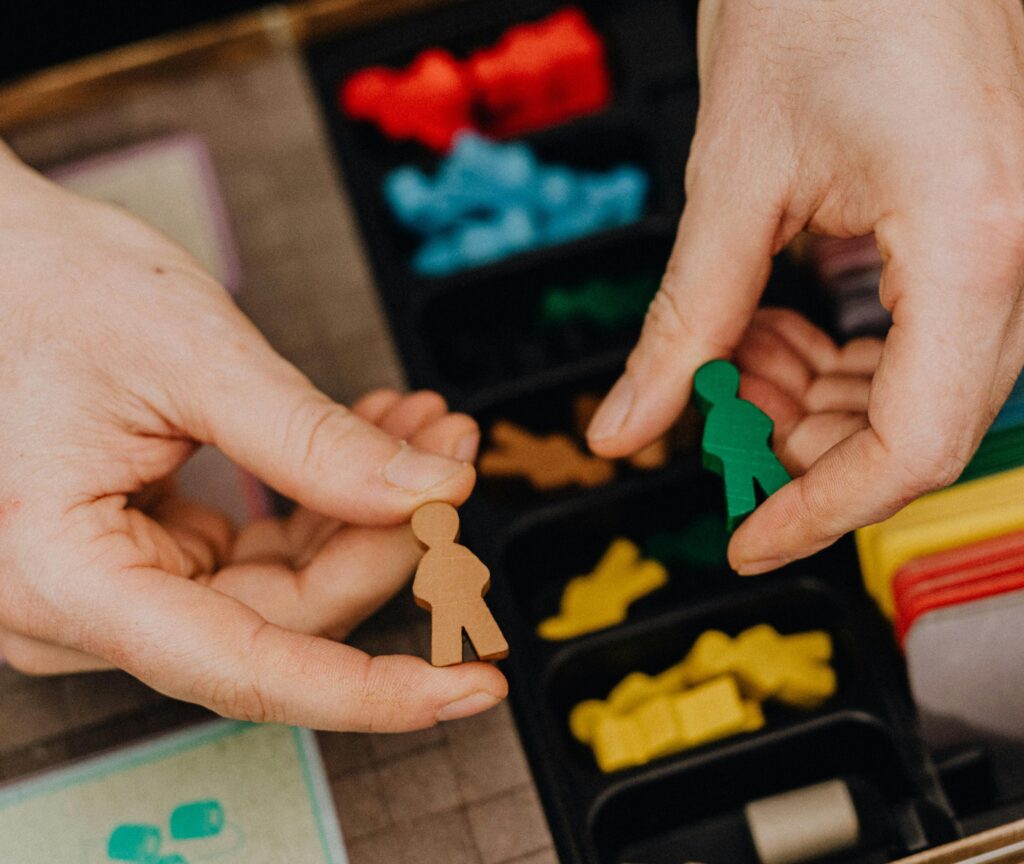
Tabletop game creators and designers often work flexibly. It is not uncommon for even successful tabletop game designers to have a day job, collaborate with other tabletop game designers, work as freelancers, serve as consultants, and be involved in multiple projects. Oftentimes, tabletop game designers may collaborate with other tabletop game designers to jointly develop a game, including the game’s unique mechanics, story, characters, and other intellectual property. However, by doing so, tabletop game designers often unknowingly create a new intellectual property where all of the creators who were involved have joint ownership in the game. Without a proper governance agreement, joint ownership of the intellectual property can lead to risks and pitfalls.
Copyright
If multiple creators develop a game together and do not have either a formal entity to own the intellectual property or a written agreement governing ownership of the intellectual property, then the co-developers will own the game’s copyright jointly and equally. While this may sound fair and equitable, in practice it introduces a whole host of potential issues. This is because each of the co-developers has the right to freely exercise any or all of the exclusive rights inherent in the game so long as they pay the other co-developers their share of any revenue earned from such use of the game.
This means that without a written agreement, each co-developer can update the game, create derivatives (including sequels and prequels to the game), create merchandise or adaptations of the game, and/or license or transfer their rights in the game to third parties, without obtaining the approval of the other co-developers. Each co-developer risks having the other co-developer exploit and use the game in a way that they may not agree with.
There are two simple methods that tabletop game developers can take to avoid this scenario.
Forming an Entity to Own the Game
The first is to form an entity that will own the intellectual property in the game. The co-developers will then own a percentage of the entity. This way, the co-developers have to make decisions through the entity’s formal legal procedures, which may include shareholder or board votes, manager votes, etc.
There are several advantages with this method. Forming a legal entity such as a limited liability company or a corporation provides a liability shield for the co-developers. If there are legal claims against the game, the co-developers have an extra layer of protection that can prevent such legal claims from seizing the co-developers’ personal assets such as their house or personal funds.
Having a legal entity can also make contracting the rights of the game easier. Instead of requiring owners to individually sign agreements for the exploitation or use of the game, the legal entity can sign the agreements instead. This means that the legal entity can serve as the signing party for agreements with contractors working on the game, licensees who wish to adapt the game, and publishers who wish to publish the game. There is also a privacy benefit to doing business through an entity rather than as individuals.
However, forming a legal entity may not always be practical for tabletop game designers. If two developers only intend on collaborating on a single game, then setting up a separate legal entity just for that one game may represent unrealistic overhead and administrative burden.
Co-Ownership Agreements
In the event that forming a legal entity is not practical, then the next best alternative is to draft a “Co-Ownership Agreement.” Under a Co-Ownership Agreement, the co-developers are still joint owners of the copyright of the game, but the agreement services to clarify and govern the use and rights of the intellectual property.
A Co-Ownership Agreement typically includes provisions governing how each co-owner can use their intellectual property. For example, the agreement could set aside certain activities that a co-owner can freely do so long as they notify the other co-owners. These permitted uses might include signing and selling copies of the games at live events such as conventions and conferences, creating and allowing others to create actual play shows of the game, and performing or allowing others to perform live-plays of the game. Other uses of the game and its intellectual property may be subject to approval by the other joint creators. This might include entering publishing deals for the game or licensing the game for book, comic, video game, and film or television adaptations.
If there are multiple co-owners, the approval threshold could be set at a simple majority or a supermajority for decisions that the co-owners determine to be more important. If the ownership percentage among co-owners allows for the possibility of a deadlock, then the co-owners may want to implement a mechanism to break the deadlock. Tiebreaking, mediation, or even arbitration mechanisms are common mechanics to break deadlocks.
Co-Ownership Agreements can also restrict how creators can develop and use the game and its intellectual property. If the game is still in development, the co-owners may want to set forth rules on how the co-creators can use artificial intelligence technology (if at all), how the co-creators would like to coordinate marketing and promotion of the game, and how losses and profits should be attributed to the co-creators if, for example, one creator expends more resources in the development of the game than the others.
Conclusion
Tabletop game development can be a deeply collaborative process. However, collaboration without proper legal structure can create significant risk for all parties involved. Whether co-developers choose to form a legal entity or enter into a Co-Ownership Agreement, proactively addressing ownership, decision-making, and revenue allocation from the outset can prevent costly disputes down the road. The right approach will depend on the nature of the collaboration, the scope of the project, and the long-term goals of the co-developers. Consulting with legal counsel can help co-developers evaluate their options and put the appropriate protections in place before any issues arise.
View all posts by this author